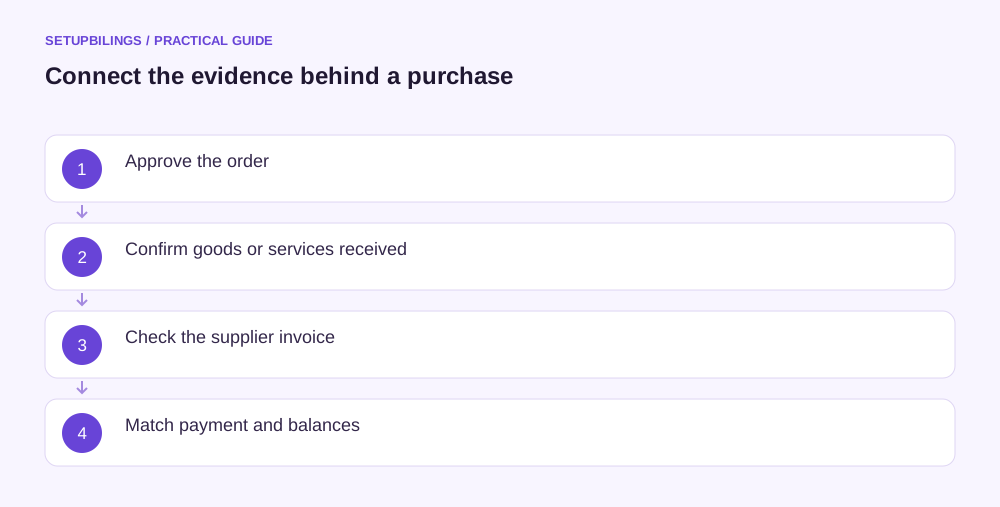
Source documents provide evidence for accounting entries. They can include invoices, receipts, contracts, delivery records, bank statements, payroll records and approved internal calculations. A reliable set of books links each entry to enough evidence for another person to understand the transaction and review its treatment.
One document rarely proves everything. An invoice may establish the amount billed, a delivery note may support receipt of goods and a bank record may prove payment. The business often needs the documents together to establish what was purchased, when it was received and whether the amount remains outstanding.
Match the evidence to the question
Consider an illustrative Hyderabad office interiors contractor receiving a ₹48,000 invoice for lighting fixtures. The invoice names the supplier and items, but the warehouse records only ₹36,000 of goods received so far. A ₹24,000 advance has already been paid.
The bookkeeper should not assume the invoice, delivery and payment are identical events. Review the purchase terms, partial delivery, invoice validity and advance allocation. The correct accounting depends on what the business has received or controls and what it owes under the agreement.
The supporting file should connect the order, supplier invoice, receipt record and payment evidence. If the difference represents undelivered goods, record and monitor it appropriately. If it is an error, obtain the correction. This prevents a payment record from concealing a delivery problem.
Understand what common documents establish
| Document | Useful evidence | What it may not establish alone |
|---|---|---|
| Supplier invoice | Billed items, price and stated terms | Actual receipt or payment |
| Delivery or service record | Goods received or work performed | Final agreed price or settlement |
| Bank statement | Movement of funds | Business purpose and correct expense category |
| Contract | Rights, obligations and performance terms | Whether performance actually occurred |
| Internal calculation | Basis of an estimate or allocation | Reliability without supporting inputs and review |
A quotation shows proposed commercial terms. It is not automatically a completed purchase. A purchase order shows authorisation or commitment but does not by itself prove receipt. A payment screenshot can be helpful, but it should be reconciled to the actual bank record and correct beneficiary.
For customer receipts, keep the remittance instruction or allocation to invoices. A lump-sum payment may settle several bills, include an advance or contain a deduction. Unexplained allocations create collection disputes later.
Build evidence for entries without supplier invoices
Not every valid entry has a third-party invoice. Depreciation is supported by an asset register and calculation. A prepayment release is supported by the original agreement and coverage period. An accrual may be supported by service completion, contractual rates and a reasoned estimate.
Suppose the interiors contractor receives March subcontract work estimated at ₹32,000, with the bill due in April. The source file can include the subcontract agreement, site completion confirmation, calculation and approval. When the bill arrives, compare it with the estimate and clear the related accrual correctly.
An internal voucher saying only “year-end adjustment ₹32,000” is insufficient for a useful review. It should explain the obligation, period, basis and accounts affected. Keep the evidence that supports the amount rather than relying on the preparer’s memory.
Check authenticity, completeness and duplication
Before posting a supplier document, verify that it relates to the business and that the supplier, date, amount and description are coherent. Match it to the relevant order or service approval. Investigate changed bank details through an established verification process before payment.
Use invoice numbers and supplier references to prevent duplicate posting. The same bill may arrive by email, messaging app and paper. A different file name does not make it a different transaction. Credits and cancellations also need to remain linked to the original record.
Check completeness in both directions. Trace a selection of ledger entries back to evidence, and review received goods or completed services for items not yet entered. A perfectly filed invoice archive can still omit bills that never reached the finance team.
Organise records around retrieval
Choose consistent file names or document references containing useful identifiers such as date, supplier and invoice number. Link the reference to the ledger entry. Retain the original record where required and preserve enough context to interpret messages or approvals later.
Restrict editing of approved documents and retain correction history. If a supplier replaces an invoice, keep a clear record of which version is valid and what happened to the earlier one. Uncontrolled replacement can cause both duplicate payments and gaps in the audit trail.
Set access according to roles and protect confidential payroll, customer and bank information. Backups should be tested through retrieval, not merely assumed to exist. A record that cannot be opened when needed is not operationally useful.
Establish a retention and handover process
Retention requirements differ by entity, tax law, document type and circumstances. Identify the applicable periods and any need to retain records longer for unresolved matters. Do not adopt a universal deletion rule based on an informal assumption.
At handover, provide the document index, ledger references, unresolved missing evidence and access arrangements. Record who will obtain each missing item. This lets the next person continue from a known position instead of reconstructing transactions from bank narrations.
Source documents make accounting explainable. Collect evidence at the time of the transaction, connect the different stages and support estimates with clear calculations. The result is a record that can answer both “what amount was posted?” and the more useful question, “why is this the right entry?”