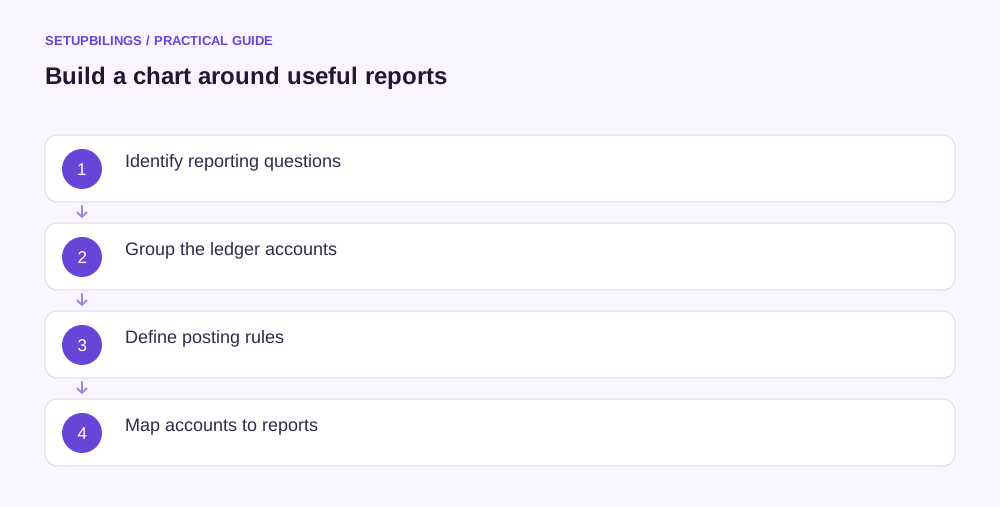
A chart of accounts is the organised list of accounts used to classify a business’s transactions. It groups balances into assets, liabilities, equity, income and expenses, with further detail where that detail supports reporting or control. Its structure determines whether the owner can understand a financial report without rebuilding the numbers manually.
The best chart is specific enough to answer important questions and simple enough for staff to use consistently. Creating a separate account for every customer or minor purchase is not always necessary. Customer records, product records and reporting dimensions can provide detail without making the main ledger unwieldy.
Begin with the reports you need
Consider an illustrative Surat cleaning-products distributor. The owner wants to review product margins, warehouse costs, customer dues and funding. A starting structure might separate sales, sales adjustments, cost of goods sold, delivery costs, administration, inventory, receivables, payables, bank, loans and capital.
Within administration, separate rent, staff costs, professional fees and other material recurring expenses. Avoid one large “office expenses” account if it prevents meaningful cost review. Equally, twenty categories for occasional small stationery items may add work without changing decisions.
Write down the reports first, then map each required line to its accounts. If delivery charges need separate analysis, decide whether customer delivery income and delivery expense will have distinct accounts. The presentation must reflect the applicable framework and the business’s circumstances, while internal reports can add clearly defined analysis.
Keep the main account groups distinct
Assets record resources such as bank balances, inventory and equipment. Liabilities record obligations such as suppliers and loans. Equity records the owner’s residual interest and relevant movements. Income and expenses describe performance over a period rather than the position at one date.
Mixing these groups causes more than untidy labels. A loan receipt posted to sales inflates income. A machine posted entirely to repairs may understate assets if it qualifies for capitalisation. A refundable deposit posted as rent can distort both expenses and recoverable balances.
| Illustrative account group | Example account | Useful supporting detail |
|---|---|---|
| Asset | Trade receivables | Customer and invoice schedule |
| Asset | Equipment | Asset register and depreciation |
| Liability | Trade payables | Supplier and bill schedule |
| Liability | Bank borrowing | Facility and repayment schedule |
| Income | Product sales | Product or category analysis |
| Expense | Warehouse rent | Location and service period |
Account codes can help organise the list, but the precise numbering system is a management choice. Leave room for future additions and use names that staff can understand. An account number cannot compensate for a vague definition.
Separate accounts from dimensions
Suppose the distributor opens warehouses in Surat and Vadodara. Duplicating every expense account for each warehouse may work in a very small setup, but it becomes cumbersome as locations grow. A consistent expense account with a location dimension may provide cleaner reporting where the recording system supports that approach.
Similarly, customer names belong in the receivables detail rather than necessarily becoming different types of revenue. Product profitability may require item-level sales and costs. Ask which information belongs in the transaction’s account and which belongs in its analytical attributes.
Do not claim a reporting capability exists without checking the tools actually used. If the business maintains a spreadsheet, document how branch and product fields are validated and summarised. The structure must be workable in practice, not merely attractive on paper.
Give each account an inclusion rule
A short account guide should explain what belongs in each category, what does not, and when staff should ask for review. For example, “repairs and maintenance” can cover routine servicing, while a major replacement requires assessment under the asset policy before posting.
For the distributor, a ₹36,000 annual warehouse service payment may initially require a prepayment rather than a full month’s expense. The chart should therefore include the appropriate balance-sheet account and the process for releasing the cost. An expense account alone does not handle timing correctly.
Include examples of common mistakes. Courier charges for customer orders may be classified differently from freight directly attributable to inventory acquisition. The correct treatment follows the applicable requirements and actual purpose, so staff need that distinction at entry.
Control additions and changes
Nominate someone to approve new accounts. Before creating one, check whether an existing account or dimension already covers the need. Duplicate accounts such as “transport,” “transportation” and “delivery miscellaneous” make comparisons unreliable.
Review unused and overlapping accounts periodically. If accounts are merged or report mappings change, preserve the transaction trail and explain the effect on comparative reports. Do not delete history merely to shorten the list.
Temporary suspense accounts need particularly clear ownership. List each unresolved item, supporting reference and next action. They should not become permanent containers for transactions nobody understands. A trial balance that agrees can still contain badly classified balances.
Keep account naming independent of individual employees. “Ravi’s expenses” becomes unhelpful when Ravi changes roles, while “travel and conveyance” with employee detail in the supporting record preserves the nature of the cost. Choose stable categories and retain the person or project as a separate reference. That makes the chart easier to maintain through staff changes.
Test the structure with real transactions
Before adopting a chart, classify a sample month of actual activity. Check owner transfers, customer advances, supplier credits, equipment purchases and prepaid services as well as ordinary sales. Then produce the intended reports and ask whether their totals are understandable.
A chart of accounts is useful when it turns consistent entry decisions into clear financial information. Build it around the business’s questions, keep supporting detail in appropriate records and maintain a short guide. That gives the owner a stable reporting foundation as activity grows.