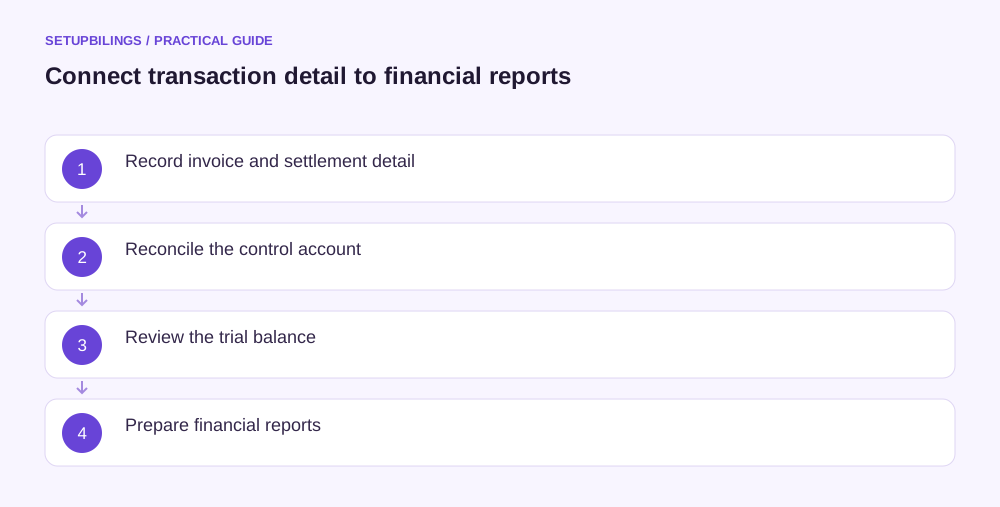
A subledger contains detailed records for a particular group of transactions or balances, such as customer invoices or supplier bills. The general ledger contains the accounts that feed the trial balance and financial statements. A control account in the general ledger can summarise the corresponding subledger, while the detail explains who owes what and why.
Both views are necessary. A receivables total helps describe financial position, but the collections team needs customer invoices and due dates. The detail should reconcile to the general ledger at the same date using the same scope and accounting treatment.
Follow customer invoices into a control total
Consider an illustrative Pune spare-parts supplier. At month end, its customer subledger shows ₹1,25,000 due from one customer, ₹80,000 from another and a ₹30,000 credit balance for a third. The net total is ₹1,75,000 before any separate allowance or required presentation adjustment.
If the general ledger’s corresponding customer control account is ₹1,75,000, the totals agree on that defined basis. That does not settle whether the credit balance should be presented with receivables or separately. It also does not prove every invoice is valid or collectible.
The subledger explains the ₹1,75,000. It identifies invoice dates, receipts, credits and customer instructions. The general ledger provides the link to the broader financial reports. Losing either side weakens the business’s ability to explain its balances.
Understand the posting flow
When a valid credit sale is entered, the customer detail records the invoice and the general ledger records the relevant receivable and revenue effects. When payment arrives, the detail clears or reduces the correct invoices and the general ledger records bank and receivable movements.
The posting may happen immediately, through batches or through another controlled process. The exact mechanism depends on the business’s tools. What matters is that the same transaction reaches both the detail and the control total once, with a traceable reference.
A spreadsheet can maintain a subledger, but separate files introduce reconciliation risks. If an employee updates the customer sheet while another posts a summary journal, the process needs clear cut-offs, batch references and checks against duplicate or missing postings.
Reconcile using the same date and scope
Start by exporting both records as of the same date. Confirm which account, customers, locations and currencies are included. Check whether adjustments such as loss allowances, tax balances or advances are inside or outside each report.
Suppose the supplier’s subledger totals ₹1,75,000 but the general ledger shows ₹1,87,000. A ₹12,000 difference requires explanation. It could be an invoice included in one record only, a manual journal to the control account or a report filter that excludes one branch.
| Possible difference | Practical check |
|---|---|
| Manual general-ledger entry | Find the journal and identify missing customer detail |
| Unposted invoice batch | Compare batch status and accounting date |
| Different report filters | Align date, account, branch and customer scope |
| Duplicate receipt | Trace payment references and allocation history |
| Opening balance mismatch | Reconcile migration schedules and imported totals |
Do not post a balancing journal merely to remove the difference. That can make the reconciliation appear complete while the customer records remain wrong. Identify the cause, correct the relevant record and retain the explanation.
Agreement still leaves important questions
A receipt posted to the wrong customer can leave the subledger total unchanged. The control account still agrees, but one customer appears overdue while another has a false credit. Invoice-level allocation and customer statement review remain necessary.
Likewise, a completely omitted sale may be missing from both records. Reconciliation checks consistency between records, not completeness against all business activity. Delivery records, service completion evidence and document sequence reviews can help identify transactions that never entered the system.
Recovery estimates also need separate review. A balanced and reconciled receivables ledger may contain disputed invoices. The owner needs an ageing and collectibility assessment, not only assurance that two totals match.
Apply the idea beyond customers
Supplier subledgers support trade payable control accounts. They show bills, credits, advances and payments by supplier. A stock subledger records quantities and costs, supporting inventory totals. An asset register supports equipment cost and accumulated depreciation, although its structure may differ from a transaction-oriented ledger.
Each supporting record should have a defined relationship to the general ledger. For inventory, quantity and valuation adjustments need a clear posting process. For equipment, additions, disposals and depreciation should reconcile. An impressive register is insufficient if its closing total never reaches the accounts correctly.
Assign responsibility for each reconciliation. State the preparer, reviewer, reporting date and outstanding items. Some differences may be legitimate timing items, but they need an explanation and expected clearance date rather than an indefinite carry-forward.
Agree how late postings are handled. An invoice entered after the reconciliation was prepared may legitimately change both records, but the reviewer needs to know whether the reconciliation has been refreshed. Record the extraction time or version where necessary and control changes to closed periods. Otherwise, two correct reports taken at different stages can appear to disagree without an obvious explanation.
Preserve detail during handovers
When changing systems or bookkeepers, transfer the open invoice and bill detail as well as the general ledger totals. A ₹1,75,000 opening receivables figure without customer references may balance the books while leaving collections unworkable.
Subledgers make totals actionable; the general ledger makes them part of a complete accounting structure. Keep their connection visible through references, controlled posting and regular reconciliation. The owner should be able to move from a financial statement balance to the individual transactions that explain it, and back again.