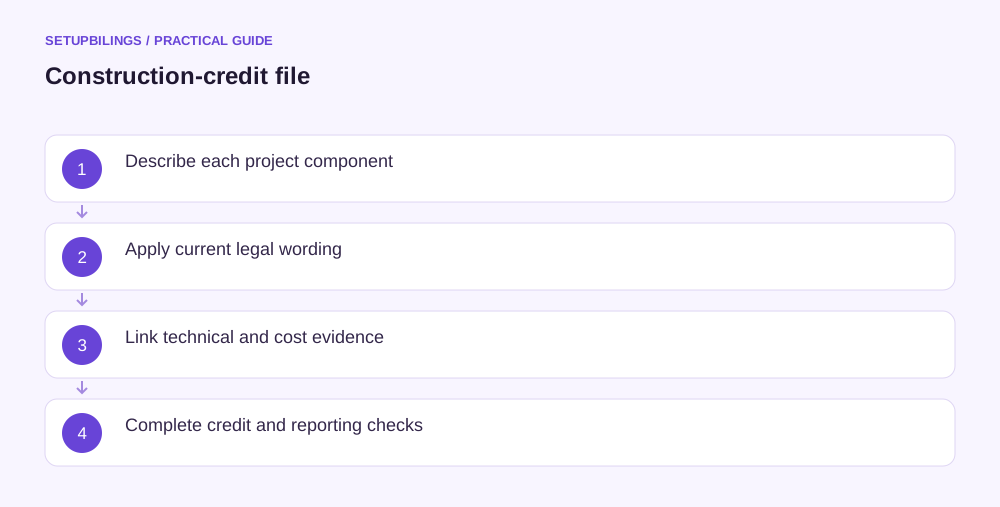
Identify what is being constructed
Construction-credit review starts with the actual asset, work and recipient. A factory building, machine foundation, office renovation and movable equipment purchase can involve different provisions. Obtain the contract, technical description and scope of work before deciding treatment from an invoice label such as civil work or installation.
Section 17(5)(c) addresses specified works-contract services for construction of immovable property, with its exceptions. Clause (d) addresses goods or services for own-account construction of immovable property, with the relevant plant-and-machinery distinction. Do not assume the two clauses are identical or that every construction input is analysed solely as a works-contract service.
Use current wording and commencement evidence
Finance Act 2025 amended clause (d) concerning plant and machinery, with the retrospective construction specified in the amendment. Current review should consider that text and its implementation, rather than relying solely on explanations based on the former phrase plant or machinery or an earlier judgment.
A Council recommendation, Finance Bill proposal and commenced amendment are different materials. Keep the operative provision and notification basis with a material claim. This is particularly important where an older opinion depends on wording that has since changed or where the business is reviewing earlier-period construction expenditure.
The amendment does not mean every machine-related invoice automatically qualifies. The statutory definition and exclusions, business use and remaining credit conditions still need assessment. A label chosen by a contractor or fixed-asset clerk cannot replace the underlying asset facts.
Separate plant and machinery from excluded structures
The statutory explanation describes relevant apparatus, equipment and machinery fixed to earth by foundation or structural support and includes the associated foundation or support, while excluding specified categories such as land, buildings and other civil structures. Review the actual engineering function and the statutory boundary.
Prepare a component schedule for mixed projects. A single contract may include machinery, foundations, a building shell, offices and utility infrastructure. The file should explain each component and the value or tax allocated to it. Do not claim all project tax merely because production machinery is one part of the investment.
Illustratively, a Rajkot manufacturer undertakes a ₹40 lakh expansion containing a shed extension, a new machine and supporting work. The review should distinguish those components and their legal treatment. A single asset entry named production expansion provides too little detail to establish which tax amount relates to the eligible category, if any.
Review own-account construction and onward contracts
Business use of an immovable property does not alone remove the own-account construction restriction. A building used for taxable operations or earning taxable rental income still needs the clause-specific review under current law. Do not conclude that charging GST on future revenue automatically makes all construction credit available.
For works-contract services used for further supply of works-contract services, examine the stated exception and actual onward contract. Preserve the customer scope, subcontractor invoices and supply relationship. A developer, contractor, property owner and tenant improving premises can have different facts and should not be grouped under one construction-industry answer.
Where an invoice includes repairs or renovation, assess whether the work falls within construction as explained in the statute, including the extent of capitalisation for the specified activities. Expensing an amount does not automatically prove it is outside the restriction, and capitalising a movable asset does not automatically make it an ineligible building.
Reconcile accounting with technical evidence
Keep the project budget, purchase orders, bills of quantities, technical drawings, completion records and fixed-asset register connected. Ask the person who understands the asset to identify what each component does. The tax reviewer then assesses the provision; an engineer's description of operational necessity is not itself a legal conclusion on credit.
Review the treatment of GST in asset cost and depreciation. Section 16(3) concerns depreciation claimed on the tax component under the applicable income-tax framework. A business should not assume the same tax amount can be both a credit claim and part of a tax-depreciation claim without reviewing the statutory interaction.
Track changes during the project. Additional civil works, alterations to a machine foundation or conversion of a movable item into an installed structure can change the factual assessment. Preserve revised contracts and values rather than extending the original eligibility note to every later variation.
Keep civil and machinery variations separately identifiable even when the contractor raises one consolidated bill. Obtain a genuine supporting breakdown tied to the contract and work performed. A rough percentage chosen after completion may be difficult to substantiate if it cannot be reconciled to quantities, engineering records or agreed prices. Review the allocation while project staff can still explain the work, rather than waiting until the asset description has been condensed for year-end accounts.
Complete the transaction and reporting checks
Even a component supported as outside the block still needs the prescribed document, correct GSTIN, receipt, business use, reporting and timing conditions. A technical classification does not cure an invoice issued to another company or an unsupported claim period. Keep those checks visible alongside the construction analysis.
Separate permanently restricted credit from temporary holds or common-use adjustments. Use the current reporting framework and retain the legal reason for each amount. If a claim depends on disputed or incomplete facts, record the open issue and the specific evidence required before authorisation.
A useful construction review produces a component-level conclusion grounded in current law and actual project records. That gives the owner an understandable account of which amounts were assessed, why the treatment differs and what evidence supports the credit claimed or restriction applied.
Sources and references
- CBIC: current CGST section 17, apportionment and blocked credits
- Finance Act 2025, section 124: construction credit amendment
- CBIC: Central Goods and Services Tax Act, consolidated through August 2021
- CBIC CGST Rules compilation through September 2021
- CBIC Circular 170/02/2022-GST: reporting ITC and reversals
- CBIC: current CGST section 16, eligibility and conditions