Classify the expense before deciding credit
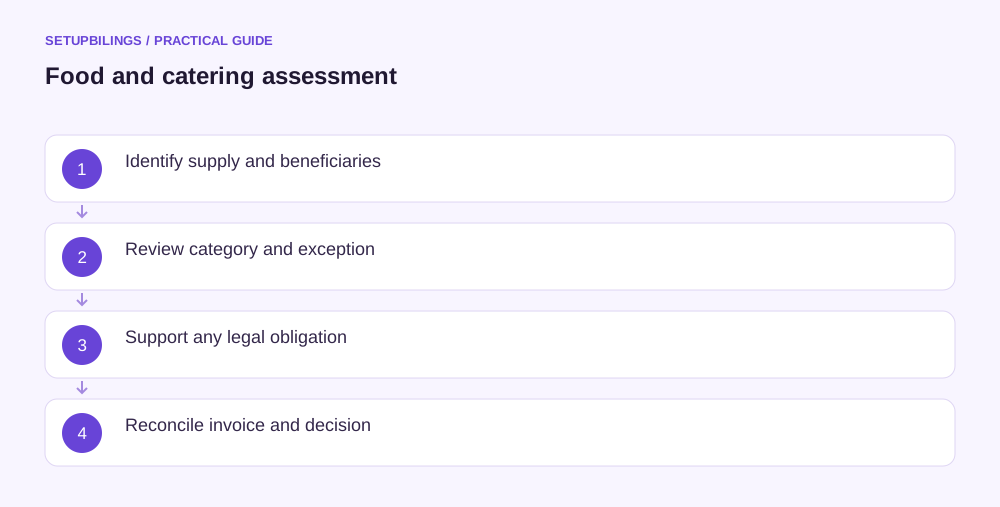
Food, beverages and outdoor catering fall within a specific blocked-credit framework under section 17(5)(b), subject to exceptions. Identify what was supplied, who contracted for it and who received the benefit. A restaurant bill, workplace catering contract and purchase of ingredients for an outward taxable food business can present different facts.
Do not use one broad refreshments ledger as the tax conclusion. Separate daily staff meals, visitor hospitality, employee functions, travel meals and inputs used for outward supplies. This makes the relevant restriction and any exception visible before the total tax amount enters the return working.
Distinguish business benefit from a statutory exception
Meals can support staff welfare or customer meetings without automatically qualifying for credit. The general business-use condition does not override the specific block. A director's approval of a customer lunch shows spending authority but does not itself establish an exception under the GST provision.
Where the business makes an outward taxable supply of the same category or uses the inward supply as an element of a taxable composite or mixed supply, review the precise statutory exception and transaction. Retain customer orders, supply classification and invoice links. Do not describe staff lunch as a catering sale merely because the business recovers a small amount from employees.
Illustratively, an event-services firm buys catering for a contracted taxable event package, while separately providing free meals at its office. Those purchases need separate analysis. Combining the invoices and claiming all tax because the firm works in events would conceal the different purposes and supply connections.
Establish any employer obligation imposed by law
CBIC Circular 172/04/2022 clarifies the employer-obligation proviso associated with clause (b). If relying on it, identify the law requiring the employer to provide the relevant food or catering facility, its application to the establishment and the employees or persons covered.
A voluntary company policy, customer expectation or general safety objective is not automatically the same as an obligation under law. Keep the actual statutory provision and supporting applicability facts with the contract. Requirements can depend on the establishment, workforce and governing legislation, so do not state one universal employee-count test without verifying it for the case.
Review the scope of the invoice against the obligation. Catering for covered workers, visitors, contractors or a separate management celebration may not all have the same factual basis. Document the populations and costs where the arrangement contains different elements instead of extending one legal obligation to every food expense in the business.
Review employee recoveries without shortcuts
Identify whether employees contribute, how amounts are calculated and what the employment or catering arrangement provides. A recovery can affect the commercial records and the output-supply analysis, but it should not be treated as automatic proof of credit eligibility. Examine the actual transaction and applicable clarification.
Circular 172 also discusses contractual employee perquisites and their supply treatment. That discussion does not mean all corresponding employer input credits are available. Keep the output-tax question, credit restriction and any legal-obligation exception as separate decisions supported by the same underlying facts.
For example, if a factory pays a ₹60,000 catering bill and recovers ₹12,000 from employees, neither figure alone determines the eligible tax. The file needs the tax invoice, actual service, governing obligation where relevant, contractual arrangement and appropriate allocation or restriction analysis.
Keep service and invoice evidence connected
Retain the catering agreement, meal period, attendance or service logs, supplier invoice and acceptance. Confirm the correct recipient GSTIN, place and tax treatment. A monthly bank payment to the caterer does not prove what services were supplied or whether an executive event has been mixed into the routine worker-meal bill.
Ask the supplier for a clear description where materially different services are combined. Obtain genuine corrections through the proper process rather than editing the PDF internally. Keep credits, cancellations and refunds linked to the original meal period and document so a later adjustment does not duplicate the claim.
Match the invoice to the relevant GSTR-2B information and other operative conditions. A statement match does not decide the blocked-credit exception, while a missing invoice entry is a separate issue from whether a food expense is substantively eligible. Record both reasons if both remain unresolved.
Keep one reconciliation between the catering service population and the employee records used in the legal-obligation assessment. If the contract adds a separate guest lounge or management event, record that change before the next claim. A monthly amount that rises sharply without a corresponding change in the covered service should prompt a factual check, not an automatic extension of the earlier exception.
Record and apply the decision consistently
Create tax codes reflecting the actual arrangements: blocked hospitality, qualifying onward-supply input where established, legally required employer provision where supported and unresolved items awaiting evidence. Avoid a single food-credit code that staff interpret differently from month to month.
Use the current return reporting framework for ineligible and reversed amounts and keep the legal reason in the workings. If a contract or legal requirement changes, reassess the future treatment rather than leaving an old exception permanently attached to the vendor name. The same caterer can supply both eligible and blocked transactions.
A useful food-and-catering review tells the owner which arrangement is being assessed and why the exception does or does not apply. That clarity allows routine invoices to be processed consistently while unusual functions, recoveries and legal-scope questions receive a focused review before credit is claimed.