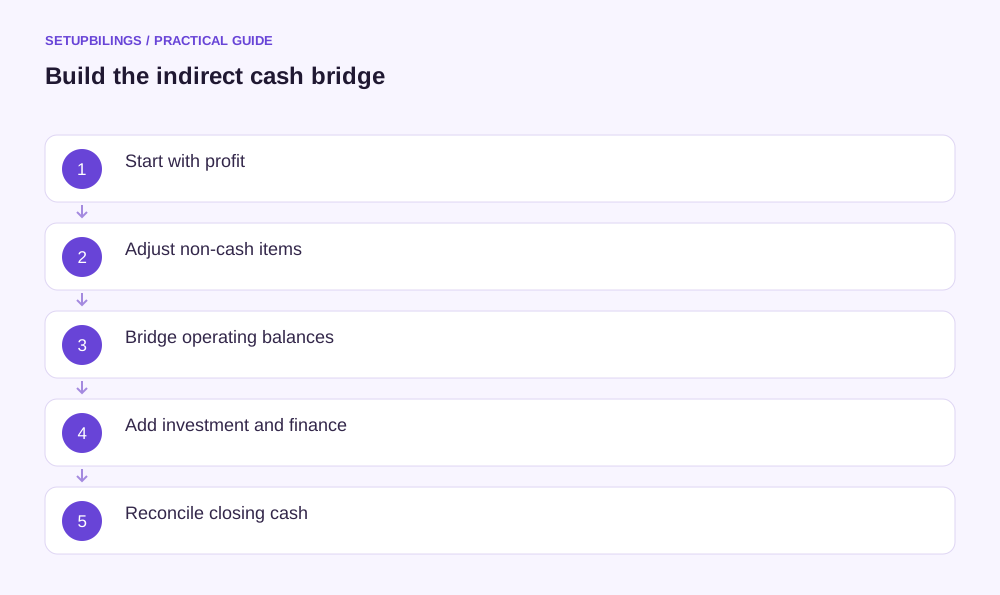
An indirect cash flow statement starts with an accounting profit measure and reconciles it to cash from operating activities. It then adds investing and financing cash flows to explain the change in cash and cash equivalents. Prepare it from adjusted financial statements and supporting movement schedules, not by reversing every balance-sheet movement mechanically.
This guide uses an ordinary non-financial enterprise applying ICAI AS 3. Classification must follow the entity’s actual framework; an Ind AS statement may have different permitted treatment in specified areas. Also check whether the entity must present a cash flow statement. A voluntary management statement can still be useful where a statutory exemption applies.
Assemble a consistent starting pack
Obtain opening and closing balance sheets, the final profit and loss statement, general ledger movements, bank reconciliations, fixed-asset workings, borrowing schedules and tax payment records. Both balance sheets must cover the same reporting perimeter and use compatible classifications.
Define cash and cash equivalents first. Identify which bank deposits qualify and which are restricted or held for investment. Transfers between items inside that definition are not external cash flows. Record the opening and closing reconciliation so you know the movement the statement must explain.
Use a working file with separate columns for opening balance, closing balance, non-cash changes, reclassifications and cash changes. This prevents a new lease, debt conversion or exchange adjustment from being mistaken for a bank payment.
Start with profit and remove non-operating effects
Profit before tax is a common starting point under the AS 3 indirect illustration. Add back expenses that reduced profit without using current cash, such as depreciation. Remove income included in profit whose cash effect belongs in investing or financing, and add back relevant expenses whose cash effect belongs elsewhere.
For example, if a non-financial enterprise applying AS 3 has interest expense, its interest cash payment is classified in financing. The expense is added back in the operating reconciliation, with the actual payment separately reported. Investment interest income is removed from operating profit and the actual receipt is considered in investing.
A gain on selling equipment is another important adjustment. If equipment with a ₹1 lakh carrying amount sells for ₹1.4 lakh, the gain is ₹0.4 lakh. Remove the gain from the operating reconciliation and show the ₹1.4 lakh sale proceeds in investing. Do not report only the gain as cash received.
Build a working-capital bridge
In a simplified operating bridge, an increase in receivables reduces cash relative to profit; an increase in inventory also reduces it; an increase in operating payables increases it. Decreases generally reverse those directions. Interpret these as reconciliation signs, not as automatic judgements about good or bad management.
Consider an illustrative Ludhiana spare-parts manufacturer with profit before tax of ₹18 lakh. Depreciation is ₹4 lakh, finance expense ₹2 lakh and gain on equipment disposal ₹1 lakh. Operating profit before working-capital changes is ₹18 + ₹4 + ₹2 − ₹1 = ₹23 lakh.
| Operating reconciliation | Amount |
|---|---|
| Profit before working-capital changes | ₹23 lakh |
| Increase in trade receivables | −₹6 lakh |
| Increase in inventory | −₹3 lakh |
| Increase in operating payables | +₹2 lakh |
| Cash generated from operations | ₹16 lakh |
| Income taxes paid, assumed operating | −₹4 lakh |
| Net operating cash | ₹12 lakh |
The tax payment is illustrative and assumes no amount specifically identifiable with investing or financing. Actual tax expense can differ from cash paid because of advance payments, balances payable, refunds and deferred tax.
Strip non-cash items from balance changes
Suppose receivables fell ₹2 lakh because an uncollectible balance was written off. That is not a ₹2 lakh customer collection. Similarly, an inventory write-down reduces stock without creating cash. Coordinate the profit adjustments and working-capital schedule so that the same non-cash item is not counted twice.
Payables require equivalent care. Equipment creditors do not belong automatically in the operating supplier movement. An asset bought on credit changes the balance sheet before the cash outflow occurs. Use invoice and settlement information to identify the investing payment when made.
Reclassifying a term-loan instalment from long-term to current also does not generate cash. Only actual borrowing receipts and repayments enter the financing cash schedule. Reconcile principal separately from interest.
Add investing and financing cash
Assume the manufacturer paid ₹15 lakh for equipment and received ₹2 lakh from selling old equipment. Net investing cash is −₹13 lakh. It received a new loan of ₹8 lakh, repaid principal of ₹3 lakh and paid interest of ₹2 lakh. Under the stated AS 3 treatment, net financing cash is ₹3 lakh.
Total cash movement is ₹12 − ₹13 + ₹3 = ₹2 lakh. If opening cash and equivalents were ₹5 lakh, closing cash should be ₹7 lakh, assuming no separate foreign-currency translation effect. Tie that closing figure to the reconciled balance-sheet components.
If the result differs, do not insert “other cash movement” without evidence. Look for omitted bank accounts, asset creditors, unpaid interest, loan reclassifications and non-cash changes. A visible unresolved difference is preferable to an unexplained balancing number.
Finish with a reviewable explanation
Keep references from each cash flow line to its ledger or schedule. Check gross investing and financing classes rather than netting unrelated receipts and payments. Document the cash-equivalent policy and disclose material non-cash investing or financing transactions appropriately outside the cash flow statement.
Finally, explain the main cause of the profit-to-cash gap. In the example, receivables and stock absorbed ₹9 lakh before supplier funding. That observation provides a concrete next step: review collections and stock demand alongside the equipment funding plan.